Intentional AI
Start with the human purpose. Choose AI when it makes the work clearer, more useful, or more possible—and bring it into the world with care.
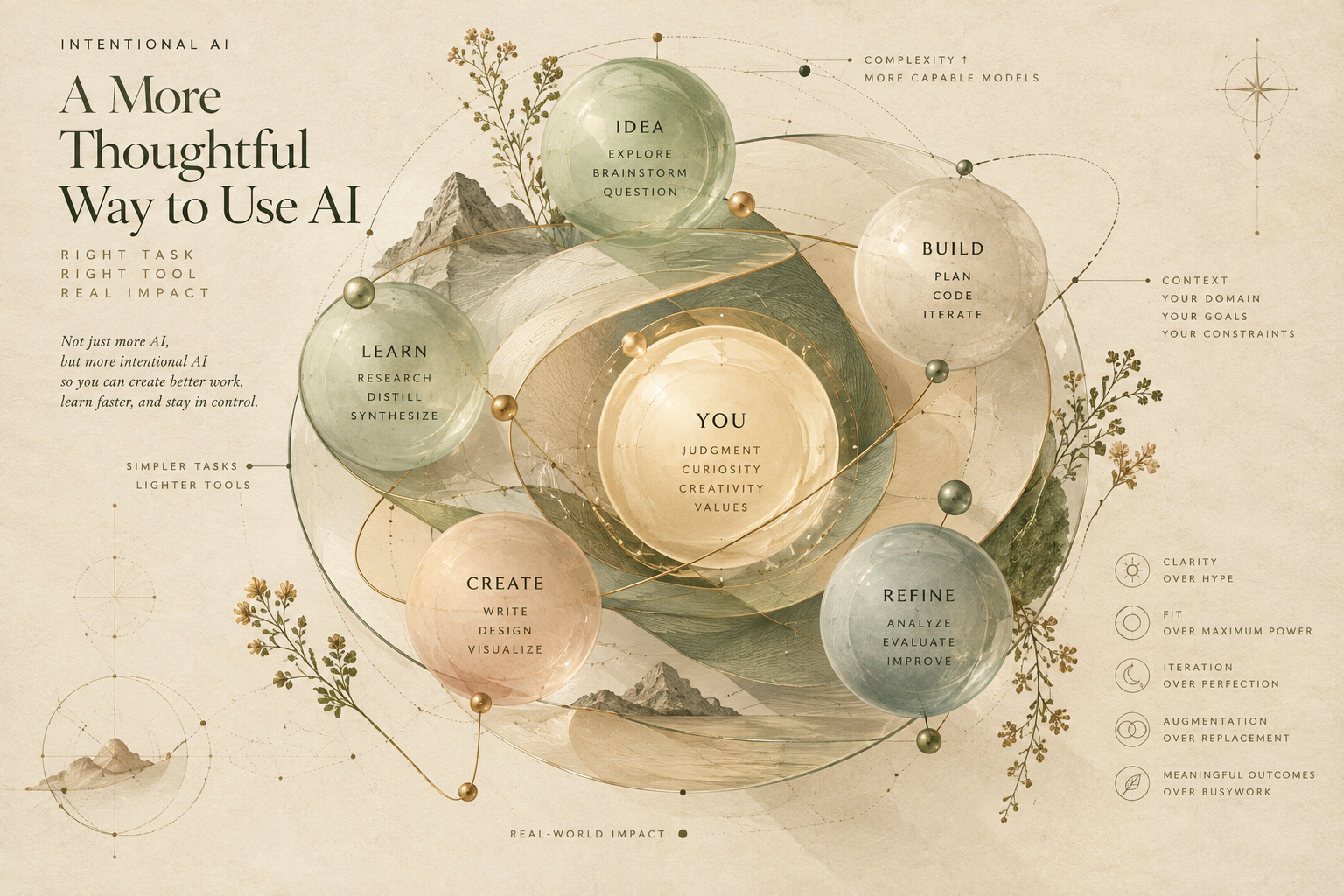
Begin with the purpose
The useful question is not “Where can I add AI?” It is “What deserves to become easier, safer, or more understandable?” That shift keeps capability in service of a real human need.
More capable models can make more things possible. Capability alone, though, does not tell us which problems matter, whose work should change, or what a good outcome looks like. Those choices begin with the person and the context.
Advance with intention. Diffuse with care.
Intentional AI is not a call to stop progress. It is a way to choose where effort goes, what constraints matter, and how new capabilities become useful in everyday life.
From advancement to diffusion
We often talk about AI as a race toward the next milestone. Diffusion asks a more grounded question: how do useful capabilities reach people, workplaces, and communities—and what happens when they get there?
Availability is only a beginning. People need access, understanding, time to experiment, and the ability to decide whether a tool fits their work. Adoption that feels imposed can create resistance; thoughtful diffusion makes room for questions, education, adaptation, and refusal.
That means paying attention to the whole path: who benefits, who carries new burdens, what skills and choices people retain, and whether the technology earns a lasting place in the workflow.
Keep people in the loop by design
In high-trust work, intention includes clear boundaries. Decide what information a system may use, what actions it may take, when a person needs to review its work, and how someone can correct or decline a result.
A human checkpoint should carry real judgment, not just rubber-stamp an answer. People need enough context and authority to understand a recommendation, challenge it, and choose a different path.
A thoughtful prototype is not an argument for automating everything. It makes one possibility tangible, lets people try it, and helps everyone learn whether it deserves a place in the workflow.
Make progress legible in human terms
Benchmarks and productivity numbers can help teams compare systems, but they do not tell the whole story. A more human set of signals asks whether a tool returns meaningful time, reduces friction, expands access, supports better decisions, or gives people more room to do work they value.
Those gains belong beside the costs: errors and correction work, loss of control, new barriers, and the resources needed to build and run the system. The point is not to turn every human outcome into another score. It is to make tradeoffs visible and ask people what changed for them.
Include the living world
AI has a physical footprint: computing depends on energy, water, land, materials, and the communities around its infrastructure. Those impacts belong in conversations about what we build and how widely we deploy it.
Responsibility cannot sit with individual users alone. Builders, providers, institutions, and public decision-makers all shape the systems and incentives. A useful question is who benefits, who bears the costs, and who gets a say?
Stewardship means seeking useful work with proportionate resource use, asking for transparent information, listening to affected communities, and improving infrastructure over time. Care for people and care for the natural world are part of the same design problem.
A useful starting brief
- Name the person and the friction they face.
- Describe the smallest outcome that would genuinely help.
- Mark sensitive information, consequential choices, and actions the system must not take alone.
- Give people a meaningful way to review, correct, or stop the process.
- Ask what changed for people and what resources the workflow required.
The goal is not more AI for its own sake. It is technology that gives people more room to do what matters, while respecting the communities and living systems that make that work possible.